

You are here:
[Cambodia-China Times] Chinese-Invested Rubber Processing Plant Comes into Operation — Hun Manet: Will Drive the Upgrading of Cambodia's Agricultural Industry
发布时间:2026.05.27
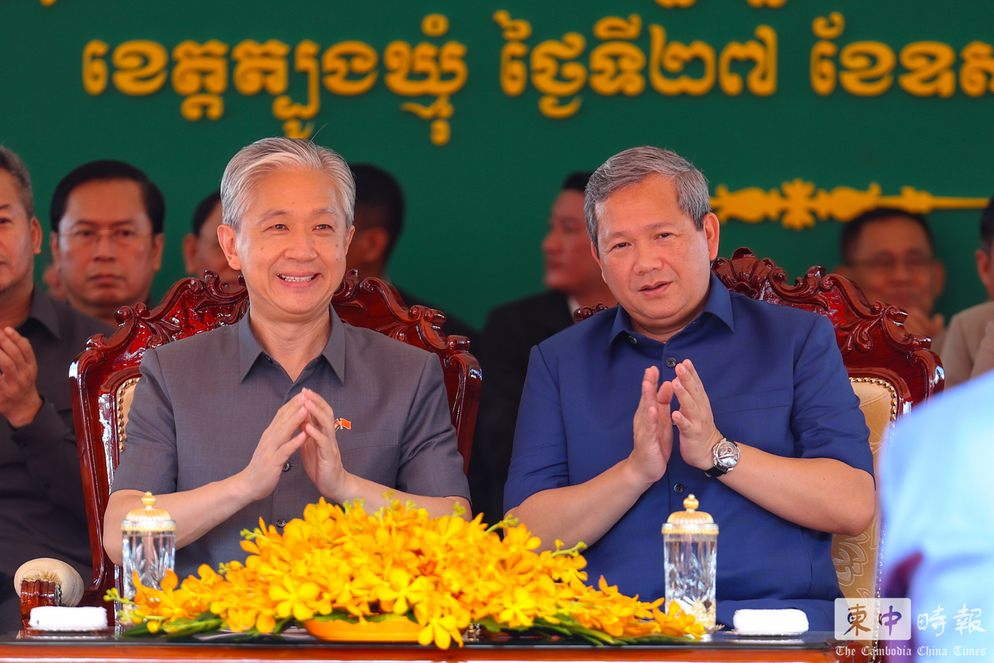
Prime Minister Hun Manet and Chinese Ambassador to Cambodia Wang Wenbin attended the ribbon-cutting ceremony. (Photo: Cambodia-China Times)
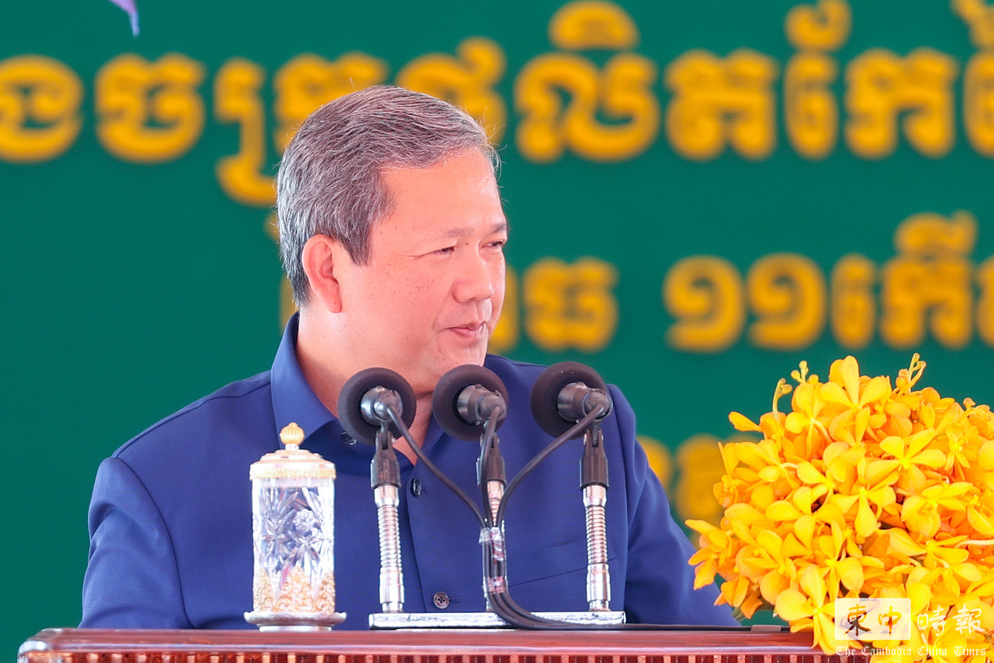
(Tbong Khmum News) Prime Minister Hun Manet stated that Cambodia will continue to promote the development of agricultural product processing, gradually transforming from exporting raw materials to exporting semi-finished and finished products, thereby enhancing the country's industrial value-added and international competitiveness.
This morning (May 27th), Prime Minister Hun Manet and Chinese Ambassador to Cambodia Wang Wenbin jointly cut the ribbon for the KIM’S RUBBER (CAMBODIA) CO., LTD. rubber processing plant, operated by China's Mainland Group and located in Tbong Khmum Province.
Prime Minister Hun Manet noted that the project represents a total investment of approximately $30 million, covers nearly 15 hectares, and has an annual rubber processing capacity of 100,000 tons. It will directly create about 300 jobs and provide indirect employment opportunities for over 50,000 people, fully demonstrating Chinese investors's confidence in Cambodia's investment environment and development prospects.
He expressed gratitude to the Chinese government, enterprises, and people for their long-standing support of Cambodia's economic and social development. He noted that China has not only assisted Cambodia's development through preferential loans, grant aid, and technical cooperation but has also continuously expanded its investments in Cambodia, making significant contributions to the country's economic growth and job creation.
Hun Manet also welcomed Mainland Group’s plan to invest in and build a second rubber processing plant in Ratanakiri Province in northeastern Cambodia. This project, with an investment of $30 million and an annual production capacity of 100,000 tons, will further drive agricultural and industrial development in the northeastern region.
He noted that rubber is one of the important strategic crops in Cambodia, and the government has formulated a rubber industry development strategy and agricultural development policies focused on promoting agricultural industrialization, agricultural product processing, and upgrading the value chain, in order to increase farmers' incomes and enhance product competitiveness.
Hun Manet noted that the first phase of the "Five-Point Strategy" implemented by the Seventh Government explicitly recognizes the private sector as a key partner in the country’s economic development and and prioritized the development of agricultural product processing. Through increasing added value, creating jobs and expanding markets, it aimed to promote rural economic development.
He pointed out that in recent years, Cambodia's rubber industry has been gradually shifting from raw material export to domestic processing. In 2025, the national rubber industry's sales revenue reached $833 million, an increase of 22% compared to the previous year. Although rubber export revenue has declined, domestic sales have continued to grow, indicating that an increasing number of rubber products are being absorbed and utilized by local factories. This is an important achievement of the government in promoting industrial upgrading.
Hun Manet revealed that in recent years, the Cambodian tire manufacturing industry has steadily increased its use of locally sourced rubber, gradually shifting from a reliance on imported raw materials to the procurement of local products, thereby fostering a development model in which agriculture and industry mutually reinforce each other.
He emphasized that the government will continue to promote closer cooperation between agricultural communities and processing enterprises, encourage the development of contract farming to ensure a stable supply of raw materials, and reduce farmers' dependence on middlemen.
Hun Manet stated that the government will continue to provide maximum convenience and support to private enterprises, including improving the business environment, reducing operating costs, enhancing the logistics system, and developing agricultural industrial parks and free trade zones, while using preferential policies to encourage more companies to use local raw materials for production and processing.
He noted that the government has designated milk, instant noodles, sugar and other products as priorities for import substitution, with the aim of gradually reducing dependence on imported goods by developing local agriculture and processing industries.
In addition, Hun Manet revealed that National Highway No. 7, a key transportation artery connecting the northeastern region, will officially open on July 7 of this year.
Hun Manet called on domestic and foreign investors to actively seize the opportunities arising from Cambodia’s agricultural industrialization, operate with integrity, deepen cooperation, and jointly promote the sustained growth of Cambodia’s economy.