


You are here:
[People’s Daily] China Helps Côte d’Ivoire Improve and Upgrade Its Agriculture
发布时间:2025.07.14
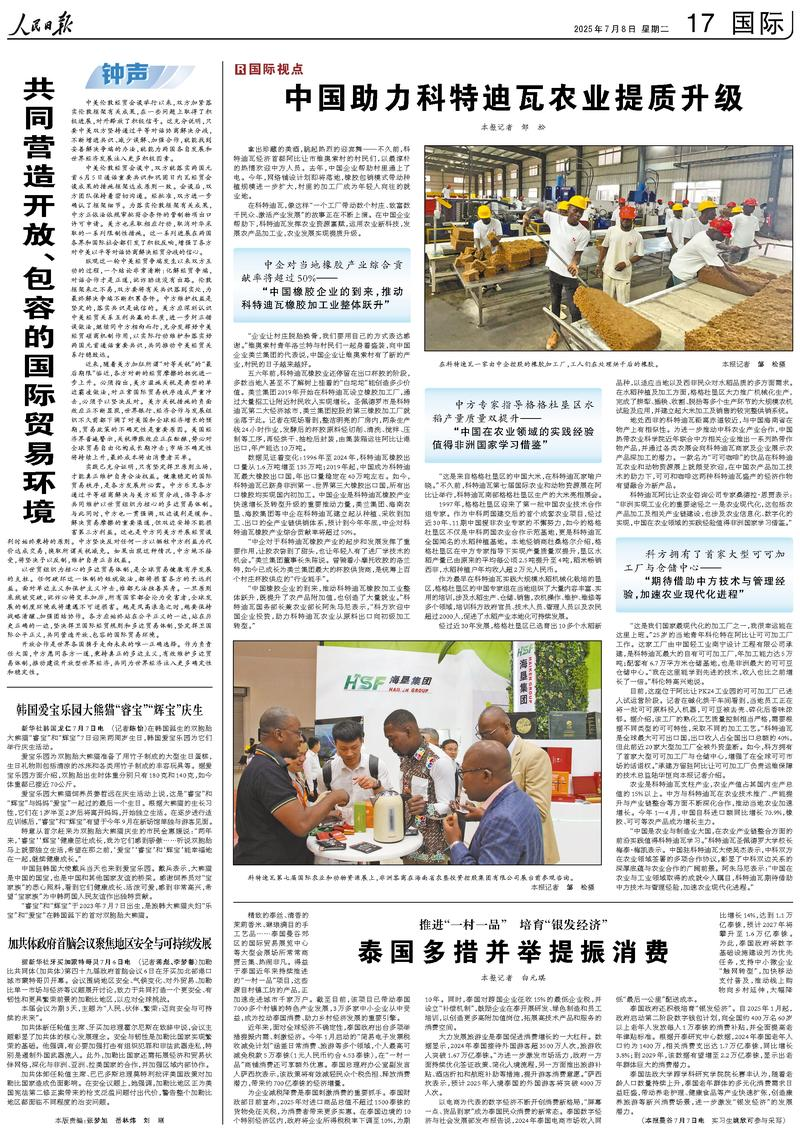
At a rubber processing plant in Côte d’Ivoire majority-owned by a Chinese company, workers are processing dried rubber. Photo by Zou Song, a reporter for this newspaper.
Bringing out their finest wine and performing lively welcome dances — not long ago, villagers of Viosso Village in Abidjan, the economic capital of Côte d’Ivoire, warmly welcomed the Chinese representatives. Last year, a Chinese company helped bring electricity to the village. This year, a network installation plan is about to be implemented, while the rubber off-take model has further expanded the planting scale, and the village’s processing plant has become a sought-after place of employment for young people.
In Côte d’Ivoire, stories like this—"One factory drives several villages, helps thousands of people increase their incomes, and stimulates industrial development" — are constantly unfolding. With the help of the Chinese company, Côte d’Ivoire is leveraging its agricultural resources, applying new agricultural technologies and developing agricultural product processing, thereby improving the quality and upgrading its agricultural development.
The comprehensive contribution of the Chinese company to the local rubber industry will exceed 50%—
“The arrival of Chinese rubber companies has driven the overall upgrading of Côte d’Ivoire’s rubber processing industry.”
“The company have transformed our village beyond recognition, and we want to express our gratitude in our own way.” ” Lorant, a young man from the village of Viosso, dressed in traditional attire alongside his fellow villagers and told the representatives of Mainland Group that Chinese enterprises have brought a new industry to Viosso and that the villagers’ lives are getting better and better.
Five or six years ago, Côte d’Ivoire’s rubber industry was still at the stage of exporting cup lump rubber, and most locals even did not realize how valuable the “white lumps” hanging from the trees could be. Mainland Group began establishing rubber processing plants in Côte d’Ivoire in 2019, increasing the income of nearby villagers by recruiting a large number of workers. Saint-Pédro is the second-largest economic city in Côte d'Ivoire. Mainland Group’s third rubber processing plant is located here. At the site, the reporter saw that two production lines were operating 24 hours a day in the clean and bright factory building. The fermented cup lump rubber underwent cutting, cleaning, mixing, pressing and other processes, followed by drying and random inspection, before being packaged and transported by container to Abidjan Port for export, with an annual production capacity of 100,000 tons.
Data bears witness to this transformation: From 1996 to 2024, Côte d’Ivoire’s rubber exports increased from 16,000 tons to 1.68 million tons. Since 2019, China has become Côte d’Ivoire’s largest export market for rubber, with annual exports to China remaining at around 400,000 tons. Today, Côte d’Ivoire ranks first in Africa and third in the world in terms of rubber exports, with all exported rubber undergoing initial processing domestically. Chinese enterprises have been an important driving force behind the rapid growth and transformation of Côte d’Ivoire’s rubber industry. Mainland Group, Hainan Agricultural Reclamation and Hainan Rubber Group, among other Chinese enterprises, have established a complete supply and marketing system covering planting, harvesting, processing and export in Côte d’Ivoire. It is expected that by the end of this year, the comprehensive contribution rate of Chinese enterprises to Côte d’Ivoire’s rubber industry will exceed 50%.
“Chinese enterprises have played an important role in the early development and growth of Côte d’Ivoire’s rubber industry, allowing rubber farmers to reap the benefits and providing young people with opportunities to learn technical skills in factories,” said Zhu Chen, the Chairman of Mainland Group. Lorant, who once rode a small motorcycle to collect cup lump rubber, has now grown to become Mainland Group’s largest supplier of cup rubber and is an “industry expert” coordinating cup rubber supplies from over a hundred villages.
"The arrival of Chinese rubber enterprises has has driven the overall upgrading of Côte d’Ivoire’s rubber processing industry, enhancing the added value of agricultural products and creating numerous job opportunities,” said Kobenan Kouassi Adjoumani, Côte d’Ivoire’s Minister of State and Minister of Agriculture. “Côte d’Ivoire welcomes investment from Chinese enterprises to help its agriculture transition from raw material exports to primary processing.”
Côte d'Ivoire, located in West Africa, is close to the equator and has similarities in its agricultural products to those of Hainan Province in China. To further promote agricultural cooperation between China and Côte d'Ivoire, the Chinese Tropical Agricultural Research Institute has recently collaborated with Chinese-related enterprises to launch a series of tropical crop products and showcase the potential for further processing of agricultural products to Côte d’Ivoire’s merchants and enterprises at various agricultural exhibitions. A beverage called “Cocoa Coffee” proved particularly popular at the Côte d’Ivoire Agriculture and Animal Resources Exhibition. With the support of Chinese agricultural processing technology, cocoa and coffee — two economic crops abundantly produced in Côte d’Ivoire — are expected to be combined into a new product.
Sandra Enja, an expert from the Agricultural Consultancy Company in Abidjan, Côte d'Ivoire, said:"One of the important ways for Africa to achieve industrialization is agricultural modernization, which includes agricultural product processing and the construction of related industrial chains, as well as agricultural informatization and digitalization. China's practical experience in the agriculture is worth learning from for African countries."
Agriculture is a pillar industry in Côte d’Ivoire, accounting for more than 15% of its gross domestic product (GDP). China and Côte d'Ivoire have continuously deepened cooperation in agricultural technology promotion, capacity enhancement, and industrial chain integration, accelerating the growth of local agriculture. From January to April this year, China's imports from Côte d'Ivoire increased by 70.9%, with agricultural products such as rubber and cocoa becoming the growth drivers.
“China is a major agricultural and manufacturing country, and its pioneering practices in agricultural chain integration are worth learning from in Côte d’Ivoire,” said Méthé Méké, President of Saint-Pédro University in Côte d'Ivoire. Chinese Ambassador to Côte d'Ivoire Wu Jie said that the multiple cooperation agreements signed between China and Côte d'Ivoire in the agricultural field demonstrate the depth of China-Côte d’Ivoire bilateral relations and the broad prospects for agricultural cooperation. Azzoumani said: "China's achievements in agriculture and industry are remarkable. Côte d'Ivoire looks forward to accelerating the process of agricultural modernization by leveraging China's technology and management experience."